holding several threads at once (2023)
waistband elastic; dimensions variable
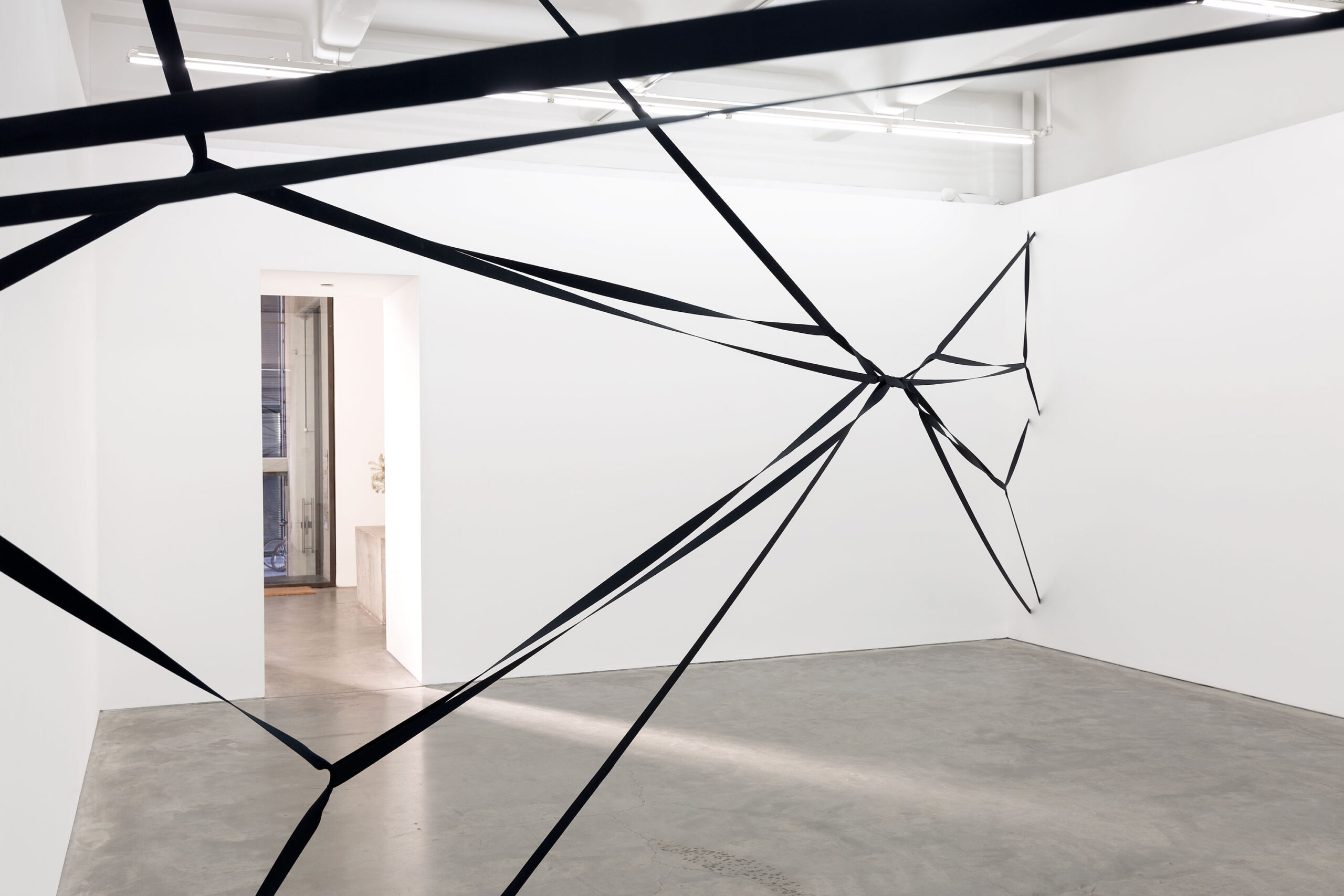
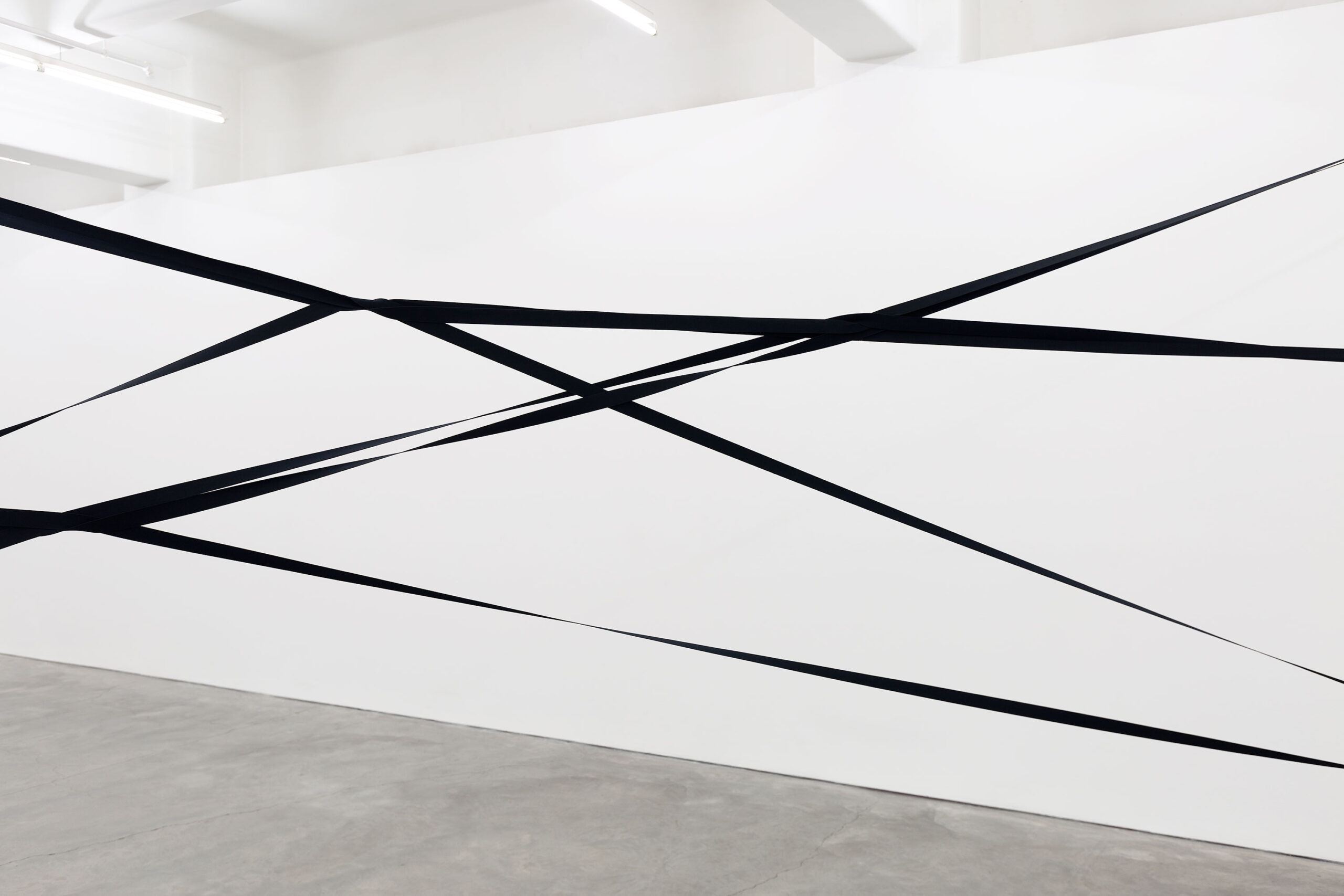
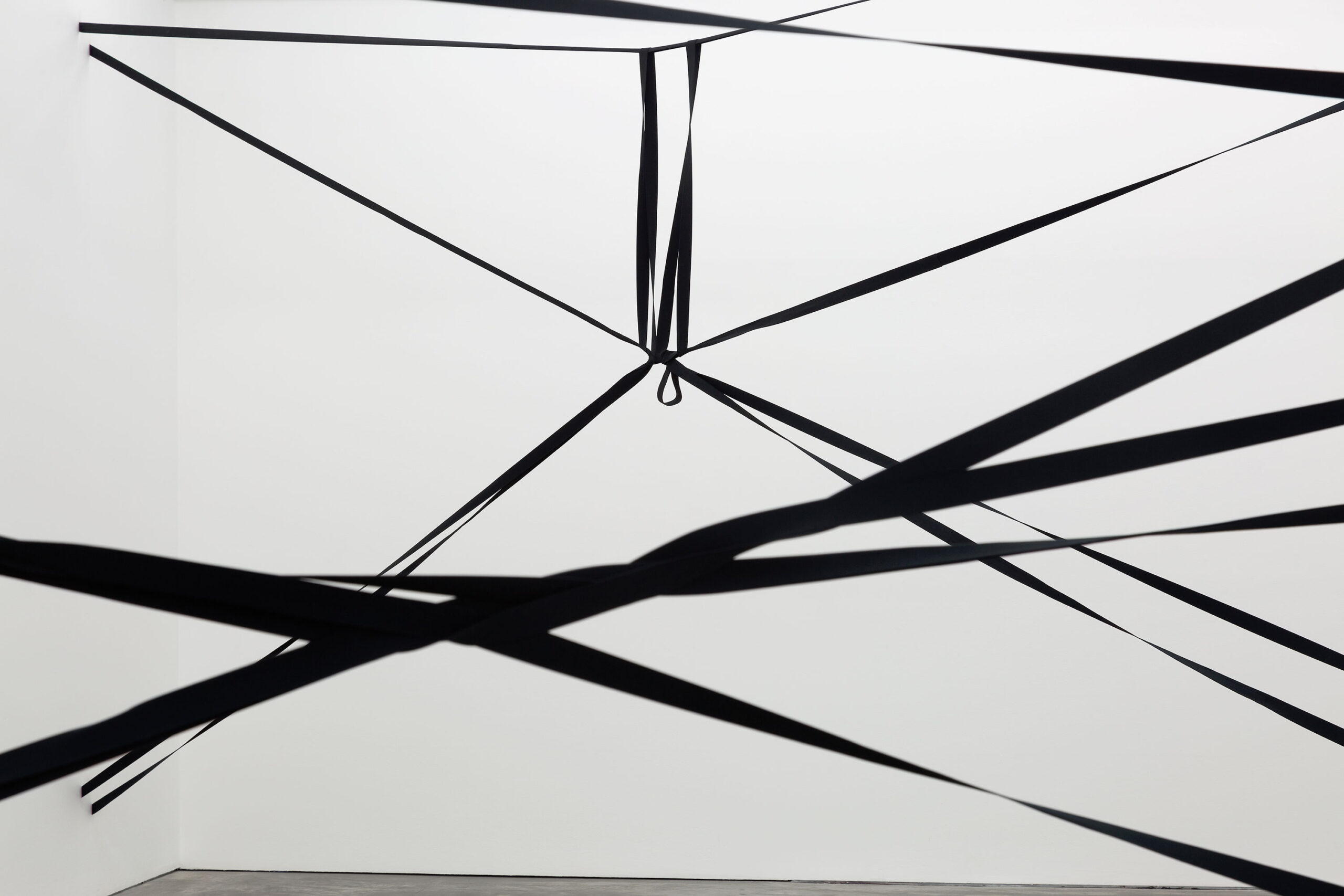
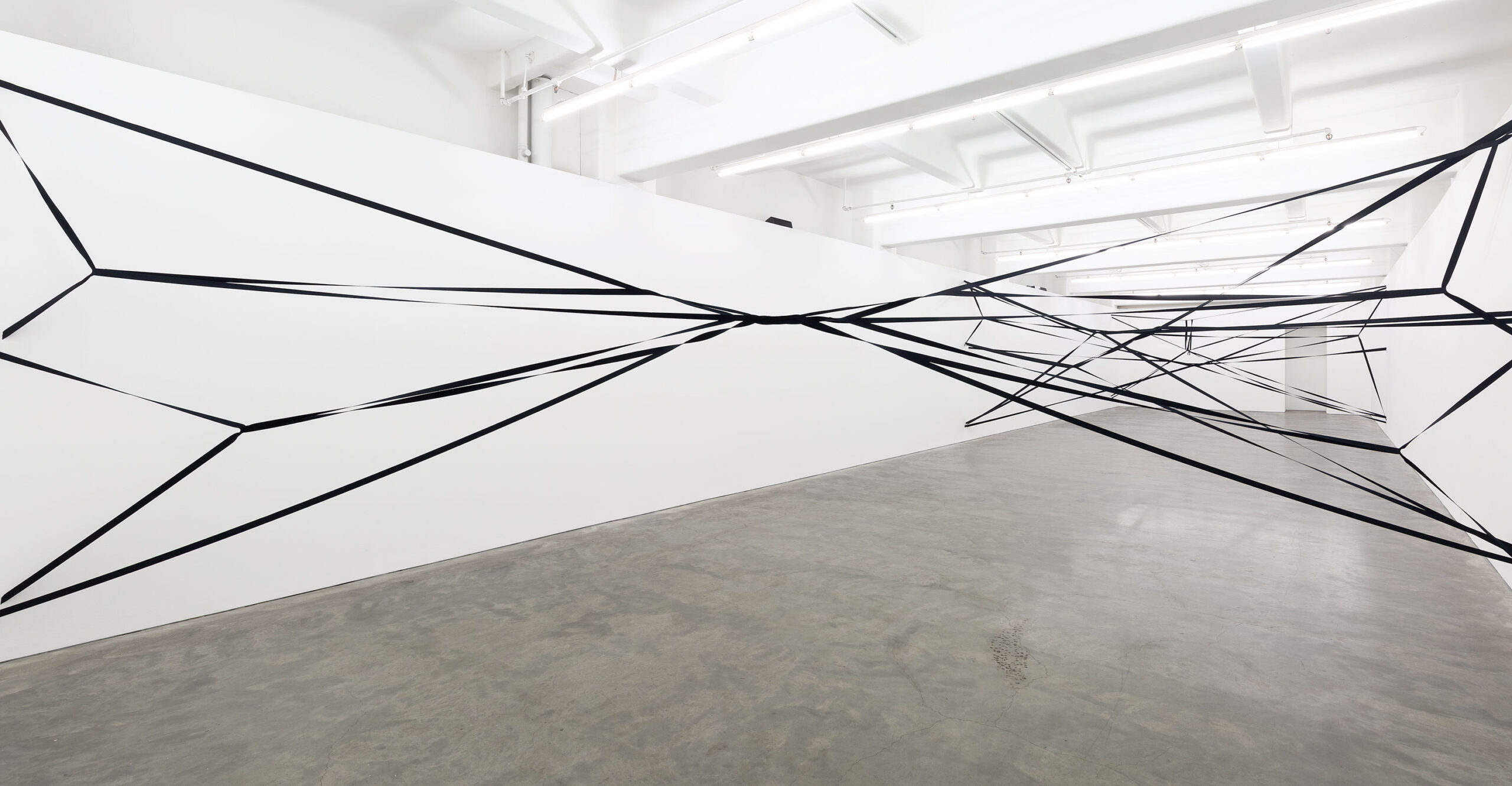
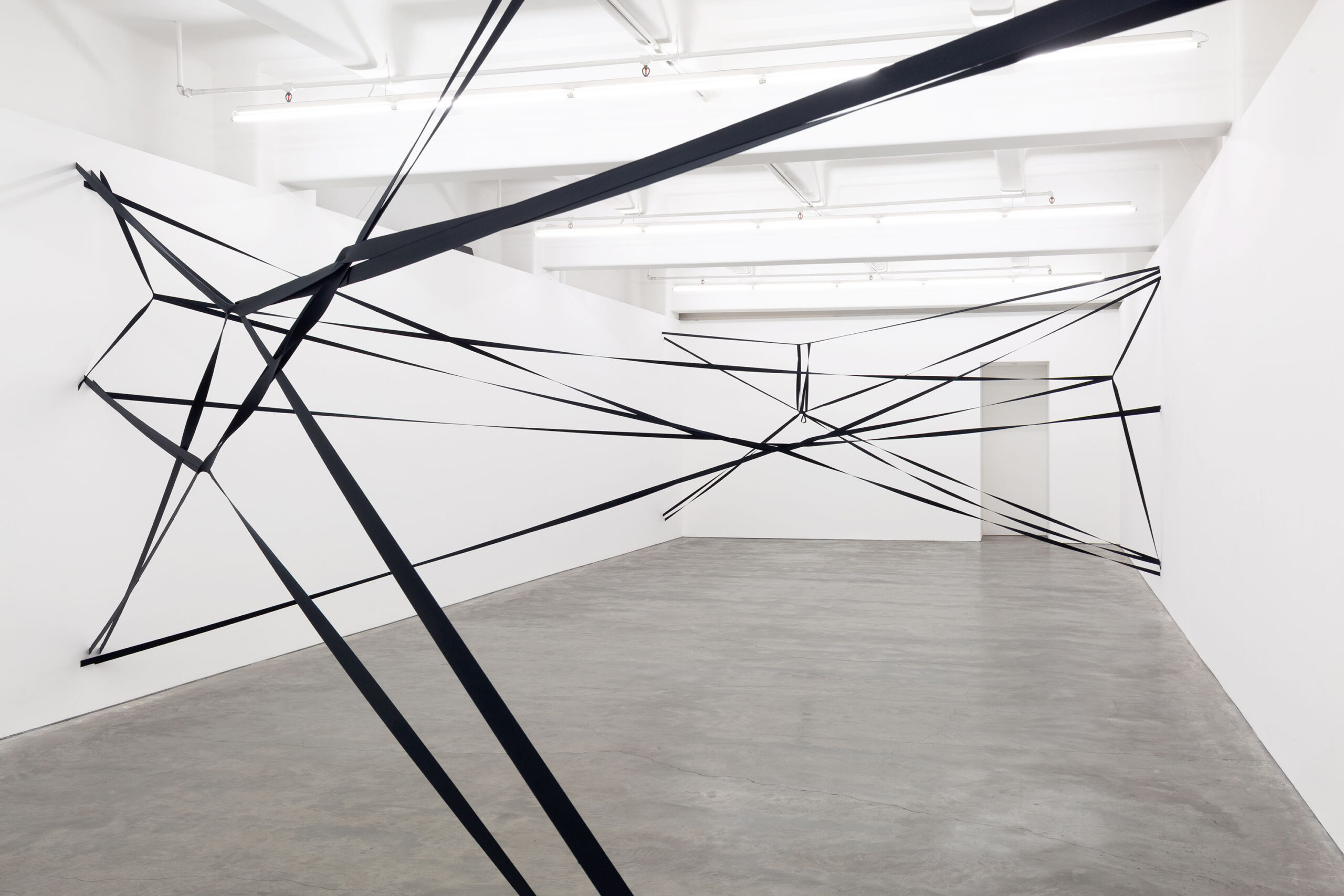
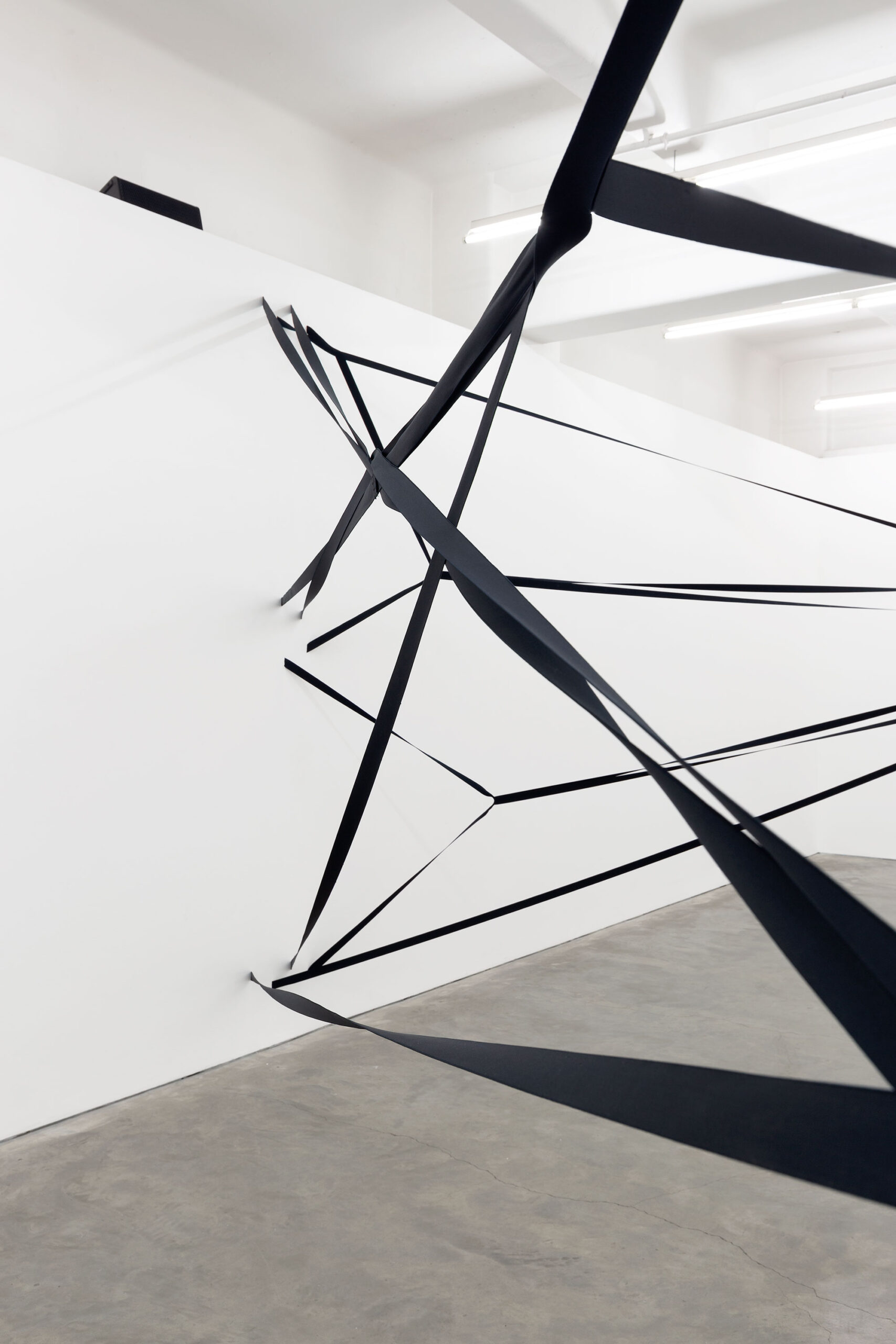
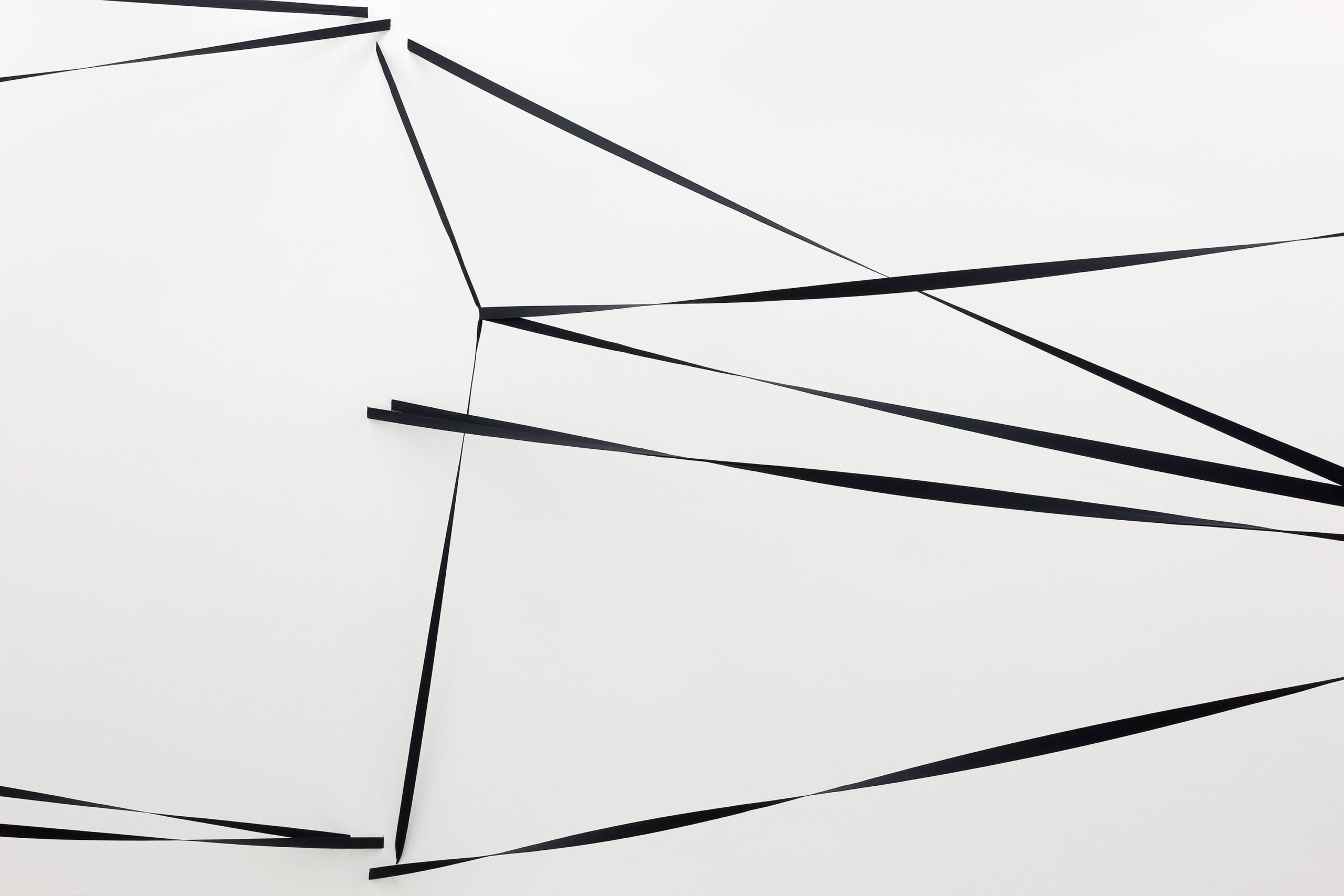
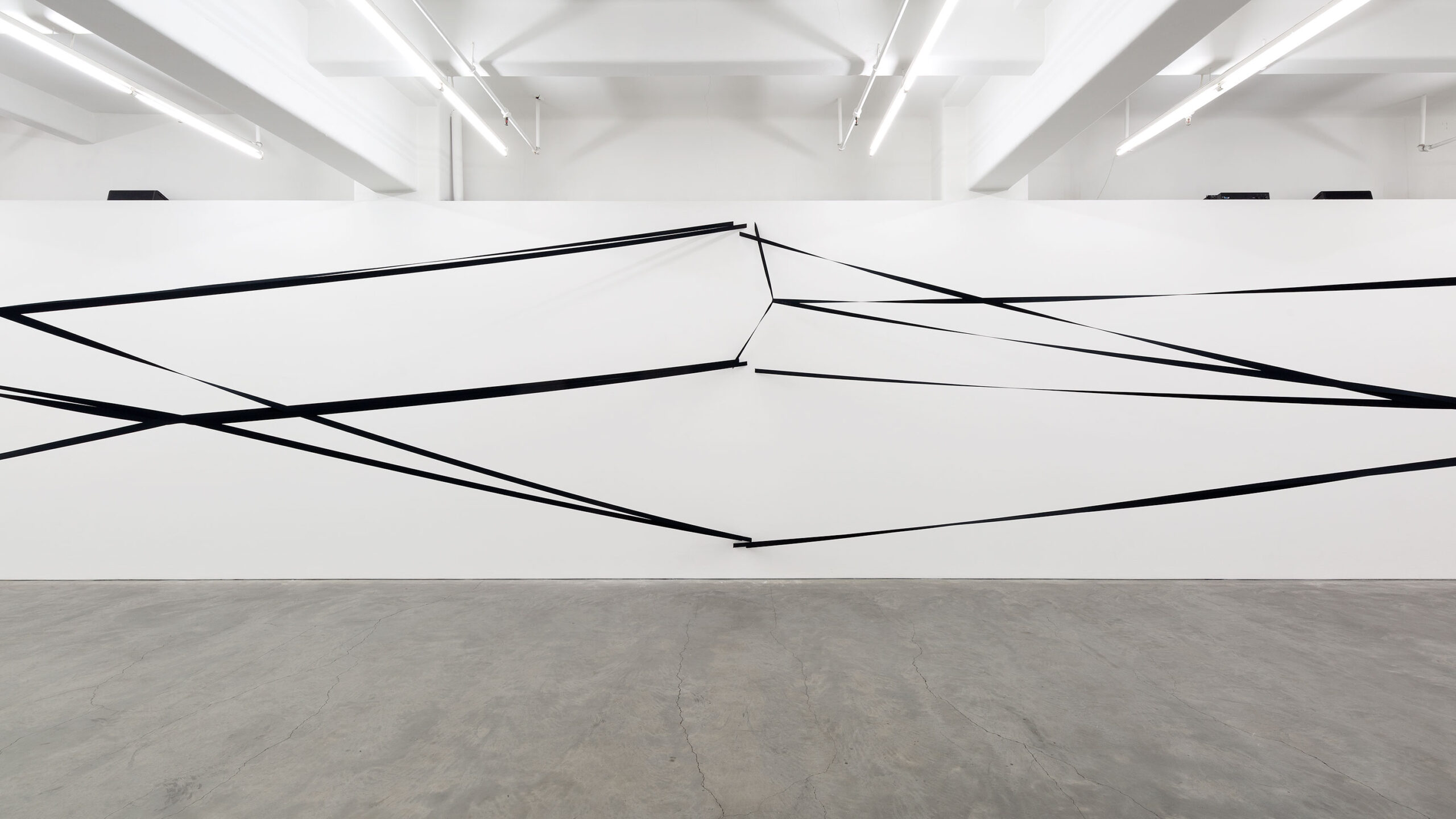
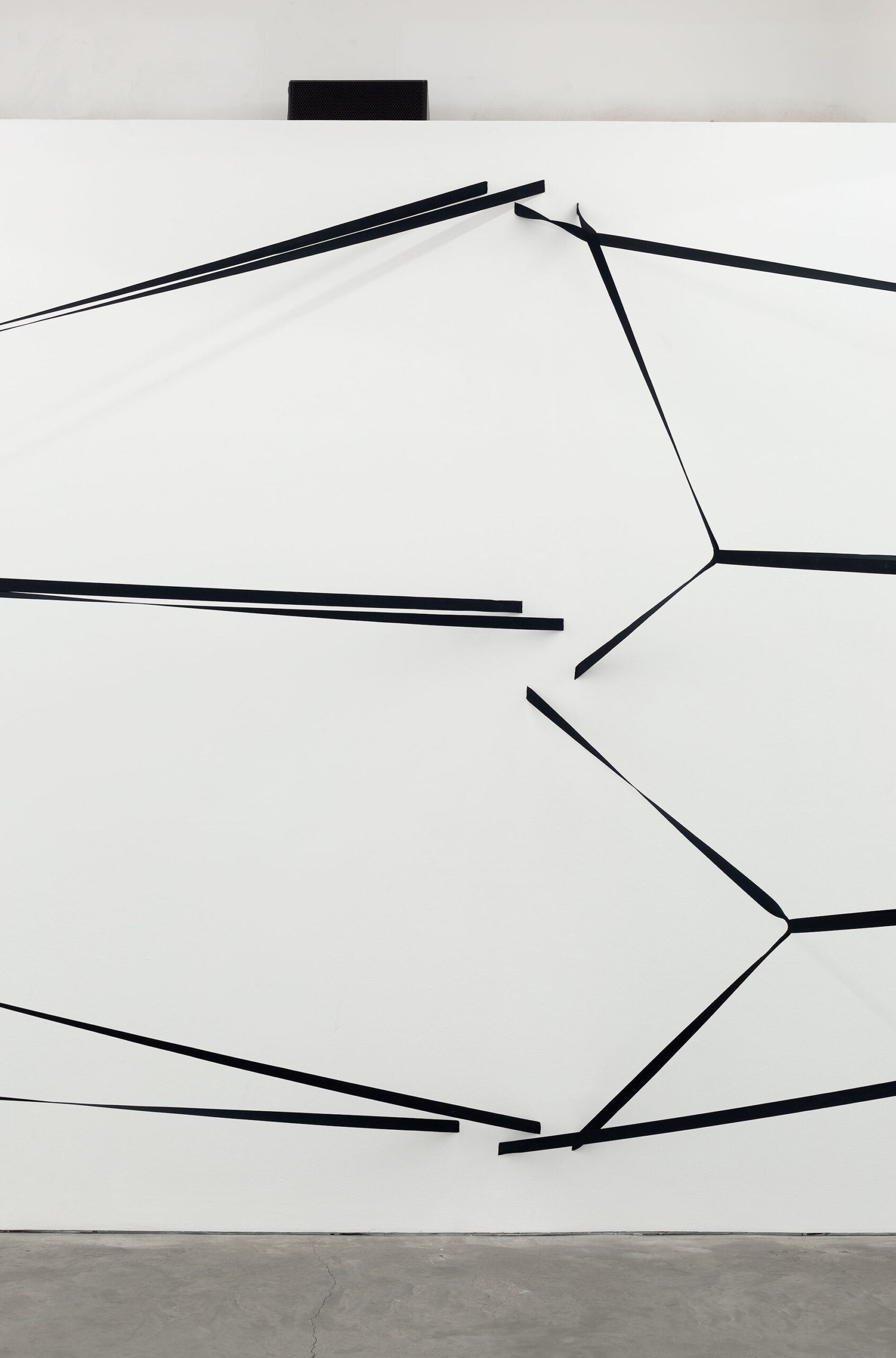
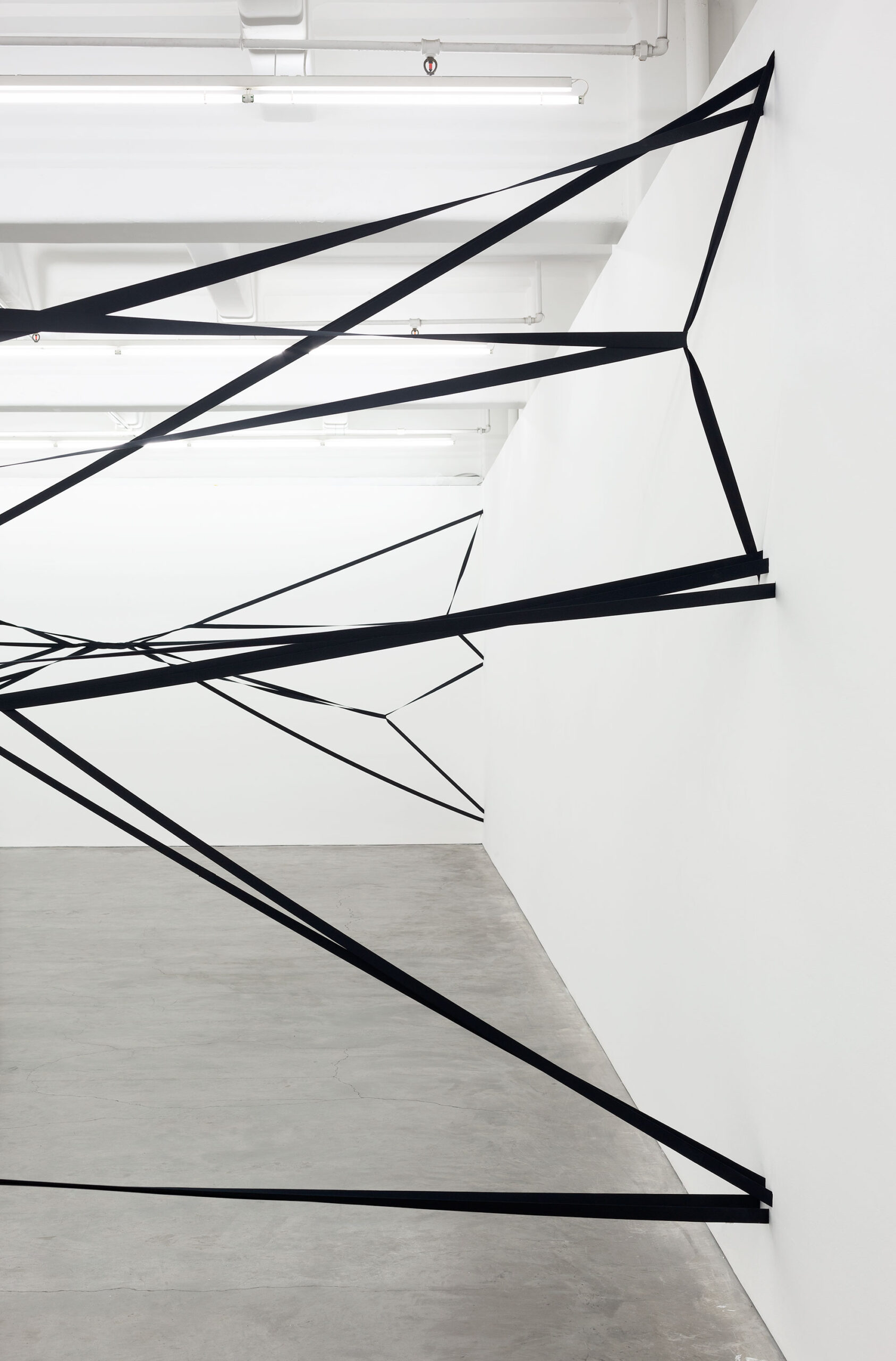
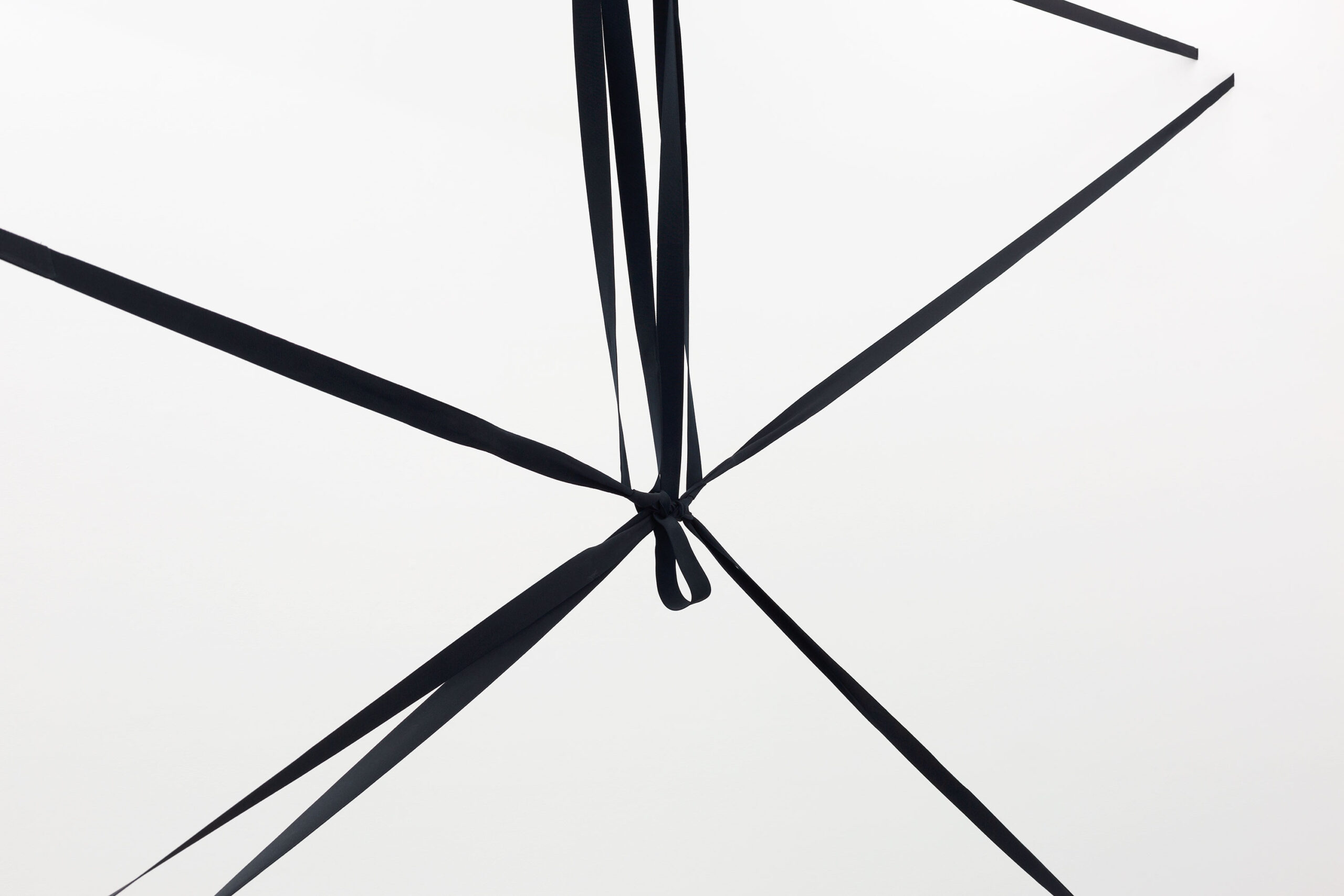
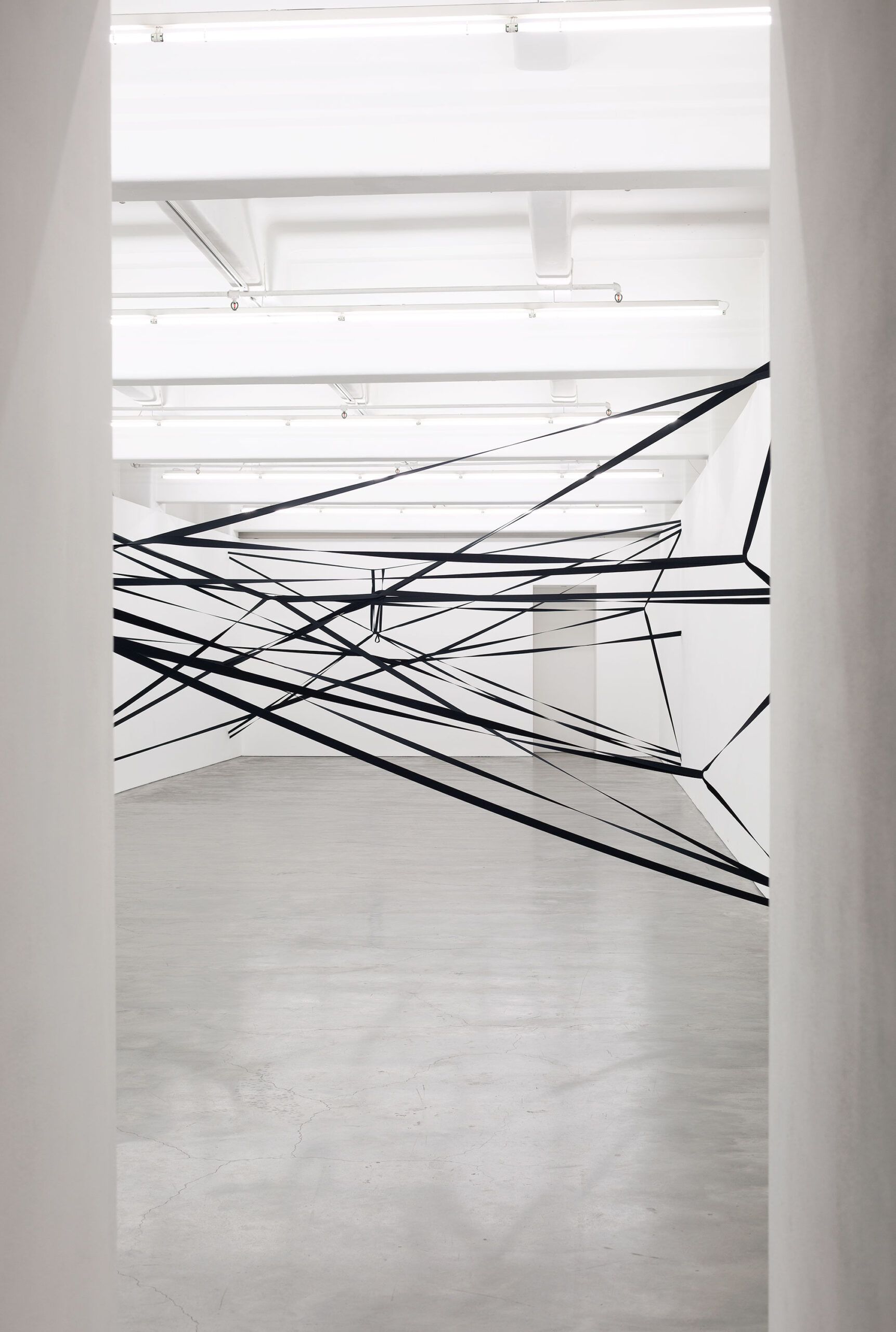
photos by Christian Capurro
For this exhibition I worked with a team of people to create four giant string figures out of waistband elastic. The figures stretched diagonally across the Anna Schwartz Gallery and threaded through the wall.
The piece was accompanied by a soundtrack by Leo Feruglio of inDAWsound and the following artist’s statement.
String figuring is thought to have been around almost as long as string itself.
According to Rirratjingu artist, composer, and activist Wandjuk Marika, for the Yolŋu people string was first made by the two Wawalik Sisters when they were on a long journey. At one point, “the sisters sat down, looking at each other, with their feet out and legs apart, and both menstruated… Each one made a loop of the other one’s menstrual blood, after which they put the string loops around their necks.”[i] Connected like this to themselves and to Country, the sisters made “a record in string of all the animals, plants and other things they saw, as well as their own activities.”[ii]The first accounts of the world were made in string figures.
String figures are understood to have been practised by many distant and diverse societies around the world. Yellowman, a Navajo man explained that string figuring helps “to relate our lives to the stars and the sun, the animals, and to all of nature or else we will go crazy, or get sick.”[iii] For the Navajo string games are a “kind of patterning for restoring hózhó, a term imperfectly translated into English as ‘harmony,’ ‘beauty,’ ‘order,’ and ‘right relations of the world,’ …. Not in the world, but of the world.”[iv] There is an ontological and relational difference in understanding oneself as ‘of the world’ compared to ‘in the world.’
This is tied to what Kombumerri philosopher Mary Graham tells her readers when she describes the deep history and practice of the relationship between humans and the land. She says, “The reflective and questing Aboriginal mind is always aligned with what everyone in the group wants, and what everyone wants is to understand ourselves in order to have and maintain harmonious relationships.”[v]
String figuring might be a way of thinking and making harmonious relationships. American philosopher Donna Haraway says “string figures are thinking as well as making practices.”[vi] She says,
“Playing games of string figures is about giving and receiving patterns, dropping threads and failing but sometimes finding something that works, something consequential and maybe even beautiful, that wasn’t there before, of relaying connections that matter, of telling stories in hand upon hand, digit upon digit, attachment site upon attachment site, to craft conditions for finite flourishing on terra, on earth. … Scholarship and politics are like that too—passing on in twists and skeins that require passion and action, holding still and moving, anchoring and launching.”[vii]
‘holding several threads at once, figuring a future together’ ties knots with these ideas.
String figuring remains a popular game in the playground and is taken seriously by mathematicians and theoreticians, historians and play experts, storytellers and artists around the world today. The figures in this exhibition are unique figures which have come about as a result of my attempts to make other figures, which is often how new figures are created. For Haraway, string figuring “belongs to no one, to no ‘one’ culture or self, to no frozen subject or object.”[viii]
Anyone can make a string figure and a string figure can be made with anyone.
Here I have made these figures with my friend, colleague and neighbour Nic Chilvers, my string figuring friend Ivylia Neimy, my dear friend and collaborator Kellie Wells, my students Olivia Smyth and Rosie Carr, my brother Matthew Bufardeci, the gallery staff Rob Campbell and Renato Colangelo, with this waistband elastic and of course with the walls themselves. It’s a privilege to exhibit with this space. My string figuring friend and mathematician Parker Glynn-Adey was an important sounding board as I was thinking through this exhibition, as were my partner Dan St Clair and my daughter Gena. I have learned much about string figuring from the International String Figuring Association website (http://www.isfa.org) which is maintained by the American biochemist Mark Sherman. Thanks to all of you.
Haraway says, “Play always involves the invitation that asks, ‘Are we a “we”’?”[ix] Yes, for sure, we are a “we.”
The ambient music is a gift to the gallery space offered in reciprocity for taking part in this exhibition and is by Melbourne-based composer Leo Feruglio of inDAW sound. Of his work he says,
“Echoes of Perception’ is an immersive soundscape meticulously crafted to accompany a captivating art installation, inviting visitors on a sensory journey through the interplay of sound and visual art. The soundscape serves as an integral component, enriching the overall experience and deepening the emotional connection to the artwork. Upon entering the installation, visitors are enveloped in a harmonious blend of ambient sounds, delicate melodies, and carefully curated audio textures. The soundscape acts as a sonic tapestry, intricately woven to enhance the themes, moods, and narratives expressed in the artwork.”
Stretched between hands, bodies and walls (and more), string figuring forms a pathway that is a pathway of thinking and doing differently. It involves setting aside ways of thinking that have constructed the world we are in and picking up some string to create a differently connected world, or to “re-world the world” as Haraway puts it.
And to that I say, “Yes! Yes! Yes!”
[i] Chris Knight, Blood Relations (New Haven: Yale University Press, 1991), 445.
[ii] String figuring is entangled with colonisation in a complex web of loss and recuperation. This account of creation along with over two hundred string figures made by the Djapu woman Ngarrawu Mununggurr were collected by the Australian anthropologist and archaeologist Frederick McCarthy in 1948. Robyn McKenzie, “The String Figures of Yirrkala Examination of a Legacy,” in Exploring the Legacy of the 1948 Arnhem Land Expedition, ed. Martin Thomas and Margo Neale (Canberra: ANU Press, 2011), 192, 201, 205.
[iii] Barre Toelken, “The Folk Performance,” in Dynamics of Folklore (Logan: University Press of Colorado, 1996), 124.
[iv] Haraway, Staying with the Trouble : Making Kin in the Chthulucene, 14.
[v] Mary Graham, “Some Thoughts About the Philosophical Underpinnings of Aboriginal Worldviews,” Worldviews: Global Religions, Culture and Ecology 3, no. 2 (1999): 108.
[vi] Haraway, Staying with the Trouble : Making Kin in the Chthulucene, 14.
[vii] Donna Haraway, Staying with the Trouble : Making Kin in the Chthulucene (Durham: Duke University Press, 2016), 10.
[viii] Donna Haraway, “A Game of Cat’s Cradle: Science Studies, Feminist Theory, Cultural Studies,” no. 1 (1994): 70.
[ix] Donna Haraway, “Anthropocene, Capitalocene, Chthulhucene. Donna Haraway in Conversation with Martha Kenney,” in Art in the Anthropocene: Encounters among Aesthetics, Politics, Environments and Epistemologies, ed. Heather Davis and Etienne Turpin (London: Open Humanities Press, 2015), 261.